






When planning a finishing booth, it’s easy to focus on the booth itself and overlook one of the systems working behind it: compressed air.
The right size compressor depends on more than just horsepower. The compressor needs to provide enough air for the number and type of air tools being used, how frequently they operate, required pressure, and the shop’s potential for future growth.
Start With Your Air Demand
The first step is to look at how much air the shop needs. Each air-consuming tool has its own Cubic Feet per Minute (CFM) requirement, so the air consumption of the tools needs to be considered together.
A small finishing shop with three employees may have several air-consuming tools, including spray guns, blow guns and other equipment. The total possible air consumption could be 118.1 CFM if every tool were running at the same time.
Of course, that isn’t how most shops operate. Not every tool is being used at the maximum capacity at the same time. For this reason, a percentage of the total CFM can be used to estimate a shop’s normal demand, with additional capacity added as a reserve for periods of heavier use.
Using 33.33% of the total 118.1 CFM gives an estimated requirement of 39.36 CFM; then adding approximately 30% for the reserve brings the requirement to about 51.18 CFM.
What Does That Mean for Horsepower?
Once the required CFM has been calculated, it can be used to determine an appropriate compressor size.
As a general guideline, reciprocating piston compressors provide about 3.5 CFM per horsepower, while a screw compressor provides about 4 CFM per horsepower.
Based on the 51.18 CFM requirement, a reciprocating compressor would put this shop around the 14.6 hp range, while a screw compressor would be around 12-13 hp - both in that 15 hp range.
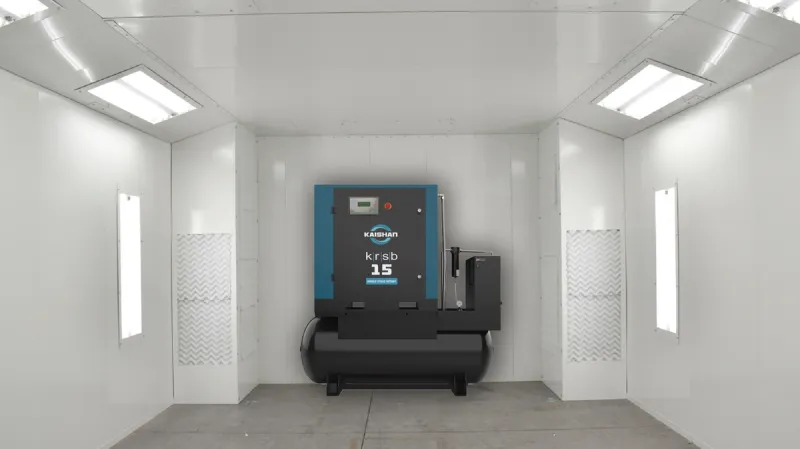
That doesn't necessarily mean one type is right for every shop. Compressor selection also depends on how often the equipment is used and the operating conditions. For a shop with this setup, a 15 hp screw compressor would be the preferred choice. With regular compressed-air demand, a screw compressor can provide consistent air delivery while operating more quietly and with less heat buildup than a comparable piston compressor.
The Compressor Is Only Part of the System
The compressor itself isn’t the only thing that needs to be sized right. The air still has to travel from the compressor to the finishing equipment, and the size and length of the air lines can affect pressure at the spray gun.
For shops needing higher volumes of air, larger piping may be necessary. The same applies to the hoses running to the spray equipment. A hose that is too small or too long can result in pressure drop before the air reaches the correct spot.
Think Beyond Today's Production
There’s also a bigger question to consider when choosing a compressor: what will the shop need a few years from now?
If more tools or additional production capacity are planned, that should be part of the calculation. Buying a compressor that only meets the shop’s current minimum requirements can mean another upgrade sooner than expected.
At the same time, going much larger than necessary means paying for capacity the shop may never use.
The goal is to find the right balance: enough capacity to reliably support the shop's actual air demand, sufficient reserve for periods of heavier use, and enough flexibility to accommodate reasonable changes in the future.
A finishing booth is only as reliable as the systems supporting it. Taking the time to understand the shop's compressed-air demand can help make sure the compressor, air lines and equipment are all working together to deliver the performance you require.
The Alberta Booth team has the experience and information you need to find the right compressor for your shop.